
https://www.gosh.nhs.uk/news/mum-chooses-to-support-research-as-a-legacy-for-her-twins/
Mum chooses to support research as a legacy for her twins
16 Nov 2026, 11:08 a.m.
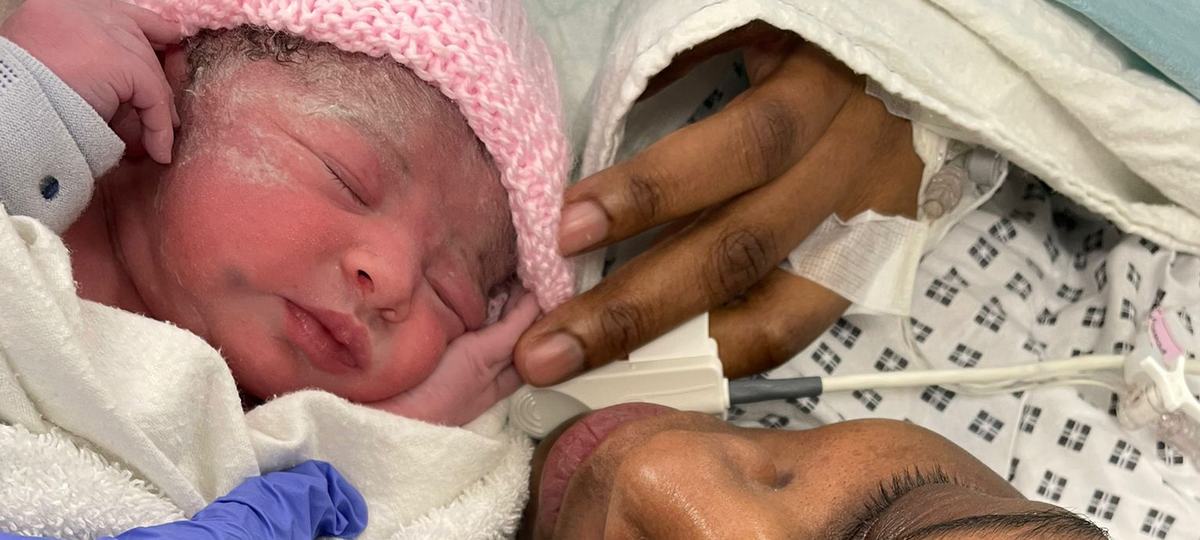
Content warning: This story, shared with consent, covers the topic of baby loss shortly after birth and has images of unwell newborns. The images are shared by their mother to show the reality of their short, much-loved, lives.
In 2023, Shanan had twin baby girls at UCLH, Amelia and Amaya. She already knew that at least one of her girls, Amaya, was seriously ill with a mass on her head but, after referral to GOSH, both twins were diagnosed with a rare and aggressive form of tissue cancer. This was a devastating time for Shanan and her family and despite everyone’s best efforts, Amelia and Amaya both passed away in the first few months of their lives.
The twin girls had shared a placenta in the womb but had separate amniotic sacs. This is quite unusual and the cancer they shared was also very rare. Shanan was approached by the research team to ask if she would like to donate samples from Amelia and Amaya to help understand how their cancers had developed and been shared.
Shanan said “People might think it’s an unusual choice to donate samples after I had just lost my girls, but I wanted to be involved in finding answers. If my girls could help other people understand, or maybe even avoid, some of the pain we have gone through, that felt like a fitting legacy for them. Maybe some good can come from a terrible place – I want to see what this research can achieve and where it can go”
She went on to say “In our darkest time, we stayed in hospital accommodation arranged by GOSH Charity – I don’t know where we would have been without them. I think my experiences have led me to my job today, where I give people in need of support a helping hand. I really want to help people because I know how important it can be to receive support when you need it.”
“This research is my loving tribute to my precious twins. It means more to me than words can express to know that their memory is living on through this vital work at the University of Cambridge and GOSH, through it, may touch and help families across the world.
“Knowing that their story could help other families facing similar journeys, deepen understanding, and perhaps even help save other little lives, brings me a gentle sense of comfort and gratitude amid the heartbreak of losing them.
“To carry their light forward in this way, to turn their story into something that may bring hope, understanding and change to others is the greatest gift I could ever give them. Their lives were precious, their story matters, and I will carry their memory with me always”.
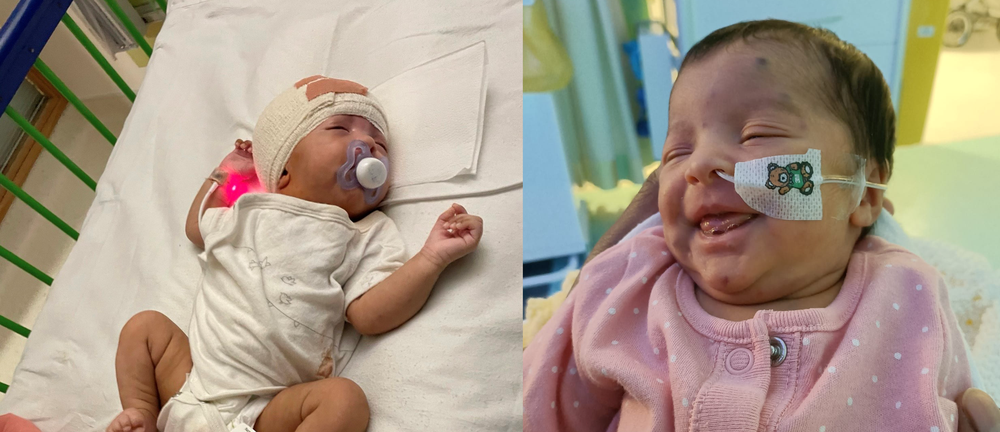
Amaya, on the left, and Amelia, on the right, passed away very early in their lives but left a lasting legacy through research.
Finding answers
Thanks to Amelia and Amaya’s donation, a recent study has reconstructed the exact sequence of molecular events that led to the two identical twins having the same cancer, which spread while they were in the womb. This work provides some long-awaited answers to the family and presents previously unknown insights into early human development.
Working with Shanan, the twins’ donated samples helped to understand the origin and spread of the cancer. Using genomic analysis, a team including those at the Wellcome Sanger Institute, the University of Cambridge, GOSH, and Cambridge University Hospitals, mapped the evolution and spread of the cancer cells at a molecular level.
They found that the cancer spread between the twins due to a rare, single event linked to blood mixing that occurred randomly. The analysis is published in Nature Communications, providing the scientific community with insight into what happened by reconstructing the order of events to help inform research and clinical care going forward.
In extremely rare cases, twins can be born with identical solid cancers, and before now, the sequence of events that can lead to this has remained elusive. In this case, experts found that the tumour cells contained a DNA change that allowed them to track the origin of the cancer to a random event in early development.
They found that the cancer cell developed in one twin (Amaya) during the first trimester and spread to the second (Amelia) through rare blood mixing in the second trimester. For Amelia, the researchers discovered that the cancerous cells had caused brain lesions during the second trimester, which were not detectable on the scans.
The researchers stress that it is an exceptionally rare event for twins to be born with cancer.
The analysis revealed that when both twins are from a single egg and are identical, the process is not necessarily a symmetrical division, despite what was previously thought. Instead, the twin’s cells developed from separate early cell lineages that came from the singular egg. Additionally, the placenta was mostly derived from cells that contributed to one of the twins, rather than being split between both.
The team also found that there was a significant amount of mixing of blood between the twins in the other direction. Given how unwell Amaya was at birth, this probably means that Amelia’s blood supply was supporting both twins inside the womb.
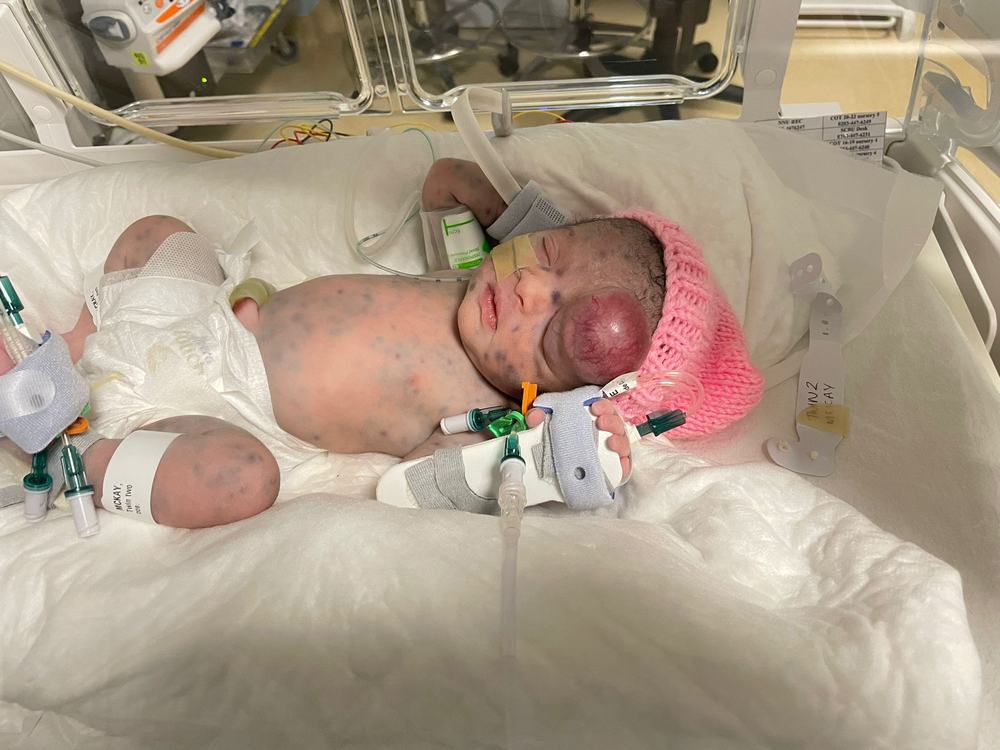
Amaya was born with a large mass on her head
A lasting legacy
By understanding the fundamental biological rules of twin development, it is hoped that further studies could be developed in the future to correlate genetic findings with pregnancy and health outcomes. This could lead to new ways to better monitor individuals pregnant with twins.
Professor Sam Behjati, who led this study and is available for interview, said: “What happened to Amelia and Amaya is devastating, and we owe it to these children to try to learn and owe their parents an answer. We are so grateful for Shanan’s decision to work on this research with us. Today’s genomic data science is an extremely powerful tool that enables us to recapitulate human development all the way from the fertilised egg to birth. On this occasion, we have been able to provide a precise answer about what, how, and when it happened, which I hope will be meaningful to parents. This can help inform future research and clinical care, hopefully helping families in the future.”
All research at GOSH is supported by our NIHR GOSH Biomedical Research Centre.

Seven years of discovery: seven researchers transforming children's lives at the Zayed Centre for Research
Seven years ago, the Zayed Centre for Research into Rare Disease in Children (ZCR) opened its doors with an ambitious vision at GOSH

GOSH and Amazon Web Services collaborate to drive digital innovation across care, research and education
GOSH and AWS have signed a Strategic Collaboration Agreement, demonstrating a shared ambition to enhance clinical care, operations, research and education through digital advancements.
Moving from Code to Clinic: how GOSH and Roche are turning data into better care
Our 5-year partnership with Roche has brought together expertise in clinical care, AI and data science to help unlock insights from complex healthcare data in a safe and secure way. Watch our new animation to learn more about the journey from code to clin