https://www.gosh.nhs.uk/our-research/drive-unit-for-digital-innovation/building-tools-to-transform-data-and-enhance-care/
Building tools to transform data and enhance care
Machine learning is a form of artificial intelligence that learns patterns from data to support decisions, rather than following fixed rules.
Our team of data experts build, test and monitor machine learning tools in-house, working closely with clinicians to ensure that the tools are clinically accurate and tailored to the needs of our hospital.
Natural Language Processing
Natural Language Processing (NLP) is a form of machine learning AI that can analyse unstructured data - such as free text in reports - and transform it into a structured format.
This makes the information easier for both humans and computers to understand, compare and analyse.
Computer Vision
Computer vision is a type of machine learning AI that enables computers to ‘see’ and interpret images - like x-rays or scans.
This allows us to create tools that support clinicians in diagnosing and treating young patients more accurately and efficiently.
GOSH was the only children’s hospital outside of North America to be awarded AWS Image Grant funding to develop a wrist fracture tool for paediatrics.
Example of tools we have built
A tool that categorises patient and family feedback into clear themes and sentiment. Now live, it has halved reporting time - from submission to staff review - enabling faster action.
Staff log safety incidents in Datix, but a long category list often leads to overuse of “Other” making it difficult to identify trends and prioritise improvements. The NLP tool automatically suggests categories based on the report, improving accuracy and enabling faster learning and safer care.
GIF structures key details from genomic reports - such as symptoms, treatments and test results - into a clear format. In one case, over 25,000 reports were processed in 4 hours, compared to an estimated 6 months manually.
X-ray summaries are recorded as free text, making large-scale analysis difficult. The XFract tool now converts this text into structured data, enabling insights and a clearer picture of fracture patterns across GOSH.
Only a very small percentage of interventional radiologists in the UK are paediatric specialists, meaning capacity is limited. The tool triages scans so only those needing expert review are escalated, reducing workload and freeing up specialist time.
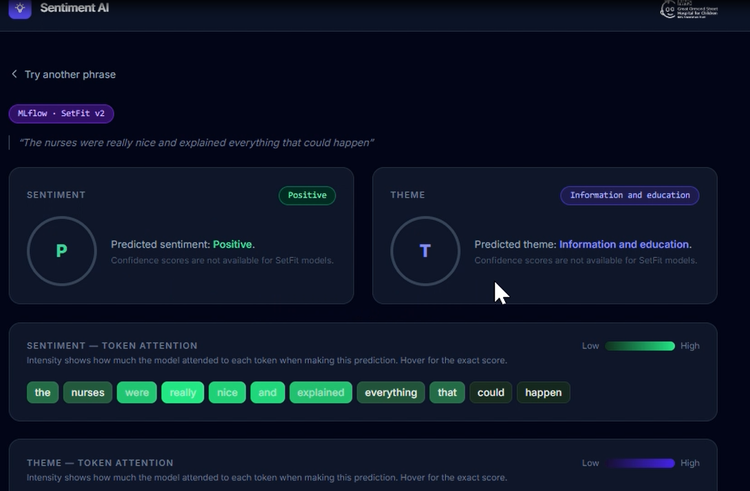
Example of our 'Friends and Family Feedback' tool which categorises theme and sentiment.
Access our publications and open-sourced code
We aim for our tools to benefit not only patients at GOSH, but children and healthcare organisations around the world.
To support this, we have open-sourced many of our tools - enabling others to access the core building blocks and adapt them for their own use.
No patient data is ever shared.
Access our open-source links and publications on our resources page by clicking here.