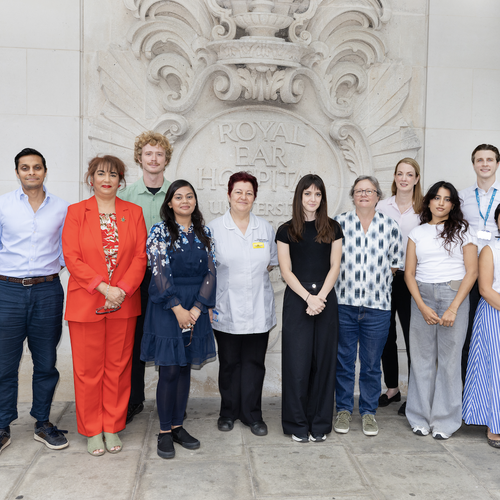
GOSH and UCL have signed a landmark agreement to simplify the commercialisation of any joint research and innovation and ensure any financial proceeds are shared equally.
A team of researchers at Great Ormond Street Hospital (GOSH) and University College London (UCL) have identified a set of genes that could be used to help doctors predict which children will respond well to treatment for juvenile idiopathic arthritis.
A toddler with a life-limiting and life-threatening rare disease is the youngest to be treated with the newest gene therapy available on the NHS at GOSH.
A new groundbreaking study led by researchers at the University of Birmingham, Great Ormond Street Hospital, University College London and Birmingham Children’s Hospital has revealed important clues into what is driving arthritis in children.
Children with a rare skin condition have found their symptoms have improved through taking part in the largest clinical trial of its kind, led by clinicians at Great Ormond Street Hospital for Children (GOSH).
An international research team led by GOSH, UCL and KU Leuven in Belgium, is using 3D-printing and nanodiamonds, to design treatments that could help babies repair their damaged lungs in the womb.
GOSH imaging researchers have worked with teams in Harvard in the USA to work out how and when our pelvises developed to be different from other animals.
New ground-breaking research by experts at Great Ormond Street Hospital (GOSH) and University College London (UCL) has led to an exciting discovery that could help children with the rare muscle disease, juvenile dermatomyositis (JDM).
Researchers at University College London (UCL), the Wellcome Sanger Institute and the University of Cambridge combined technology that determines the genetic or RNA sequence of individual cells with powerful 3D imaging to look at lymphatic vessels
Results from the largest cohort of children who received a gene therapy for a rare immunodeficiency condition have shown the long-term safety and efficacy of the curative treatment.
A major study which analysed anonymised health records from over 14 million children in England has shown that rare heart and inflammatory issues were more likely - and lasted longer - after COVID-19 infection than after vaccination.
An exciting new study hopes to improve the care of children and young people with chronic pain who experience sudden bursts of pain that breaks through medication – known as breakthrough pain.